
Author: PeerVoice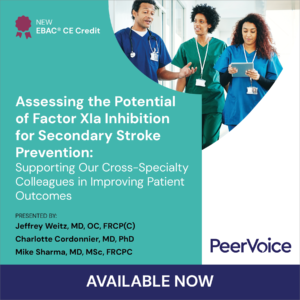
On 12 July 2026, PeerVoice hosted the CE-Accredited symposium “Assessing the Potential of Factor XIa Inhibition for Secondary Stroke Prevention: Supporting Our Cross-Specialty Colleagues in Improving Patient Outcomes” at the ISTH Congress in Paris. As factor XIa (FXIa) inhibitors are being investigated as a potential strategy for secondary stroke prevention, haematologists have an important role in understanding the emerging evidence and its implications for thrombosis, bleeding, and antithrombotic management. The on-demand version of this session is endorsed by ESO and is now available to watch free of charge. To access the program, please click here.
This educational activity explored whether FXIa inhibition could improve prevention of recurrent stroke without increasing bleeding risk. Jeffrey Weitz, MD, OC, FRCP(C); Charlotte Cordonnier, MD, PhD; and Mike Sharma, MD, MSc, FRCPC, discussed the biological rationale, phase 3 evidence, and potential clinical implications of this emerging approach.
Why Target Factor XIa?
Charlotte Cordonnier highlighted the continuing unmet need in secondary stroke prevention. Recurrent stroke remains a substantial risk despite current treatment, while more intensive antithrombotic approaches can increase haemorrhage. FXIa is therefore of interest because it appears to contribute more to pathological thrombosis than to physiological haemostasis, raising the possibility of preventing thrombosis while preserving normal clotting.
Evidence From OCEANIC-STROKE
Mike Sharma reviewed the phase 3 OCEANIC-STROKE trial, which randomised 12,327 patients with recent non-cardioembolic ischaemic stroke or high-risk transient ischaemic attack (TIA) to the investigational FXIa inhibitor asundexian or placebo alongside antiplatelet therapy. Asundexian significantly reduced recurrent ischaemic stroke, with a hazard ratio of 0.74, and effects were consistent across prespecified patient subgroups. Importantly, this benefit was achieved without a significant increase in bleeding.
International Society on Thrombosis and Hemostasis (ISTH) major bleeding occurred in 1.9% of patients receiving asundexian versus 1.7% receiving placebo. Rates of clinically relevant non-major bleeding, intracranial haemorrhage, and minor bleeding were comparable between treatment groups, supporting the hypothesis that selective FXIa inhibition may reduce thrombosis while preserving haemostasis.
Looking Towards Clinical Practice
Jeffrey Weitz led the panel in a discussion that emphasised that any future integration of FXIa inhibitors into practice will require multidisciplinary collaboration, particularly around antithrombotic therapy, bleeding assessment, and peri-procedural management.
The ongoing LIBREXIA-STROKE trial evaluating milvexian will provide further evidence. For now, FXIa inhibitors remain investigational, but the findings discussed during the activity suggest a potentially important new direction for secondary stroke prevention.
ESOC is Europe’s leading forum for advances in research and clinical care of patients with cerebrovascular diseases. ESOC 2027 will live up to its expectation, and present to you a packed, high quality scientific programme including major clinical trials, state-of-the-art seminars, educational workshops, scientific communications of the latest research, and debates about current controversies. Learn more.
