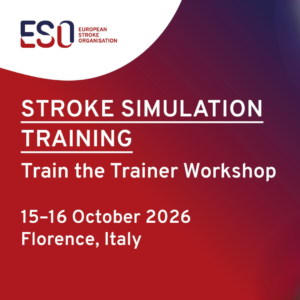
 Author: Bastian Volbers
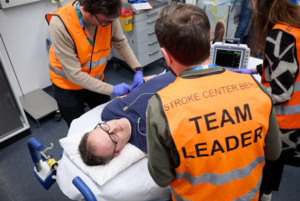
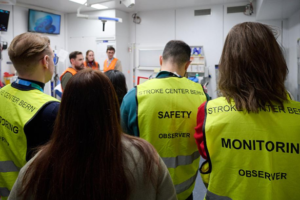
With over 7 million people dying from stroke annually, stroke is a leading cause of death and disability. Rapid treatment responses are crucial to achieve effective outcomes. Simulation education has been shown to improve timely decision-making related to reperfusion treatments, stroke pathways, organisational aspects of multidisciplinary stroke management and clinical outcomes. An effective stroke response involves interdisciplinary collaboration, with team communication and effective cooperation being especially essential. These are key learning objectives of simulation training.
The European Stroke Organisation (ESO) Simulation Education Committee was established to advance stroke education through simulation and to broaden access for physicians and paramedics involved in stroke care across Europe. Over recent years, multiple simulation workshops have been successfully delivered at ESO Congresses. However, wider implementation requires structured training for instructors to enable dissemination at the local and regional levels. The present Train-the-Trainer workshop, therefore, aims to expand simulation training opportunities by equipping participants with the skills to design scenarios and plan and conduct simulation programmes tailored to their specific clinical environments.
The target audience of our workshop comes from multiple disciplines (neurologists, stroke physicians, neuro-interventionalists, nurses, etc.), enabling multidisciplinary and harmonisation of treatment paradigms. Our program is designed to provide attendees with advanced skills in the pedagogy of simulation to improve educational experiences for their institution, region or country. Participants will be enabled to set up their own simulation program and train local acute stroke care teams. It is anticipated that the flow-on effect will improve care delivery and clinical outcomes for patients with stroke.
Who should apply?
Selection criteria:
This highly interactive workshop is designed for neurologists, neuroradiologists, interventionalists, nurses, and other health professionals involved in acute stroke care who want to develop or strengthen simulation-based training programs in their institutions.
The emphasis is on interdisciplinary team performance, communication, and workflow optimisation in acute stroke care. Purely catheter-based or technical interventional simulation procedures are not part of the programme.
Selection of participants:
Applications from multidisciplinary teams are especially encouraged. For example, a physician and nurse applying together from the same institution may gain even greater benefit when implementing simulation training locally.
Importantly, the learning experience will continue beyond Florence: an online follow-up session in April 2027 is planned to support participants as they implement simulation training at their own centres also including the possibility for further networking within an alumni forum.
ESOC is Europe’s leading forum for advances in research and clinical care of patients with cerebrovascular diseases. ESOC 2027 will live up to its expectation, and present to you a packed, high quality scientific programme including major clinical trials, state-of-the-art seminars, educational workshops, scientific communications of the latest research, and debates about current controversies. Learn more.
