Author: Anna Poriechna
Host Institution: Stroke Center of Karolinska University Hospital, Stockholm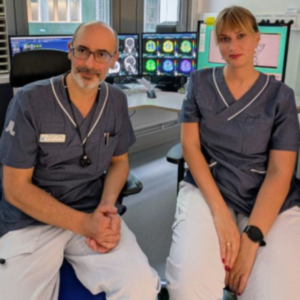
As part of the ESO TF4UKR Department-to-Department Visiting Programme, I had the privilege of completing a ten-day internship at the Stroke Center of Karolinska University Hospital in Stockholm this summer.
First and foremost, I would like to express my heartfelt gratitude to Professor Mazya and his team for the warm welcome, hospitality, patience, enthusiasm, humour, and genuine human attitude — as well as for answering all my questions and for generously sharing their time.
I was deeply impressed by the work of the department — above all, by its logistics, clear division of responsibilities, and system-based organisation. The level of practicality stood out: clear algorithms, tables, and reminders — everything readily available and thoughtfully designed. Workspaces are organised in a way that allows clinicians to be both comfortable and maximally efficient. The technical and material resources are equally impressive — state-of-the-art CT scanners and a cath lab that truly feels like a spacecraft.
Continuous education, meetings, case discussions, team-based decision-making, and multidisciplinary consultations are an integral part of daily routine. The professionalism of the nursing staff is exceptional. However, the most important aspect is how people work. Almost silently. Quickly. Without unnecessary words. Everyone knows their role, performs it precisely, and is able to “read the room”. This approach results in remarkably short door-to-needle and door-to-groin times and, ultimately, better patient outcomes.
I also observed a higher average age of treated patients, milder or well-compensated comorbidities, and a seemingly lower incidence of severe strokes — a reflection of long-terminational investment in primary prevention and the active, healthy lifestyle of the population.
Yes, this is about funding and national health policy. But even more, it is about systems — systems that are built over years, often from within, slowly and sometimes painfully, through difficult and unpopular decisions, persistence, and the courage to defend what is right. And, above all, it is about people — the people who carry these systems every single day. I am deeply grateful to everyone involved in my internship experience for a renewed sense of inspiration to grow, improve, and implement what I have learned in my own clinical practice.
(And to Stockholm as well — a city I truly fell in love with.)
ESOC is Europe’s leading forum for advances in research and clinical care of patients with cerebrovascular diseases. ESOC 2027 will live up to its expectation, and present to you a packed, high quality scientific programme including major clinical trials, state-of-the-art seminars, educational workshops, scientific communications of the latest research, and debates about current controversies. Learn more.
