YSPR Design Research Workshop.Interview with Martina Gaia Di Donna and Maria Rosaria Bagnato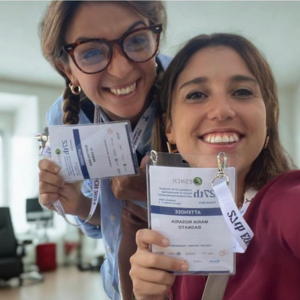
Martina Gaia Di Donna and Maria Rosaria Bagnato are stroke physicians at F. Spaziani Hospital, Frosinone, Italy, with complementary expertise in neurodegeneration and neurovascular ultrasound. Their award-winning collaborative research, developed during their PhD training at Policlinico Tor Vergata (Rome), focuses on cerebrovascular biomarkers, ARIA, and anti-amyloid therapies at the intersection between stroke and Alzheimer’s disease.
What is the main goal of your current research project?
The main goal of our project is to identify a reliable, dynamic biomarker to stratify the risk of amyloid-related imaging abnormalities (ARIA) in patients undergoing anti-amyloid therapy. We are focusing on cerebrovascular reactivity, assessed by transcranial Doppler, as a functional marker of vascular vulnerability. Importantly, we see this not only as a safety tool, but also as a potential marker of treatment efficacy, as ARIA itself reflects vascular amyloid removal and cerebrovascular instability.
What do you hope will be the most important outcome of your work?
We hope our work will contribute to a more comprehensive approach to monitoring patients treated with anti-amyloid therapies. If validated, cerebrovascular reactivity could become a simple and repeatable bedside tool to assess both safety and treatment response in real time. This would support more personalized therapeutic strategies in a field that is rapidly evolving but still lacks dynamic biomarkers.
What has been the most surprising finding in your research so far?
One of the most interesting findings has been the strong relationship between cerebrovascular reactivity and biological profiles across the Alzheimer’s disease continuum. In our recent work, we observed a significant association between Breath Holding Index, APOE genotype, and plasma p-tau181, with distinct vascular patterns emerging across genotypes. This highlights how vascular dysfunction is a central and biologically meaningful component of the disease (Di Donna MG, Bagnato MR et al., Alzheimer’s & Dementia: Translational Research & Clinical Interventions, 2026, DOI: 10.1002/trc2.70250).
What are the next steps for your project after ESOC?
At this stage, our project is still in a very early phase, with a limited number of patients enrolled and ongoing data collection. Our next step is to better understand whether cerebrovascular reactivity, assessed by BHI, can effectively support the follow-up of patients undergoing anti-amyloid therapy. In particular, we aim to clarify whether it can help detect signals of treatment efficacy, reflect the risk of adverse events such as ARIA, and improve patient stratification and selection, especially in relation to APOE genotype. These aspects are particularly relevant in a field where many mechanisms are still not fully understood.
Why are meetings like ESOC important for early career researchers?
Meetings like ESOC are particularly important when working on new and rapidly evolving topics such as the intersection between stroke and neurodegeneration. In early-stage projects like ours, they offer a crucial opportunity to receive feedback, gain new perspectives, and refine research strategies. They also foster collaborations, which are essential for developing multidisciplinary projects in areas where knowledge is still limited.
What advice would you give to young physicians who are considering a career in stroke research?
We would encourage young physicians to embrace collaboration and interdisciplinarity. Our project was born from the integration of two complementary backgrounds—Martina Gaia Di Donna in neurodegeneration and cognitive disorders, and Maria Rosaria Bagnato in neurovascular ultrasound and stroke medicine—bringing together the Dementia Center and the Stroke Unit at Policlinico Tor Vergata. We developed this work alongside our PhD training and clinical careers, and we are now both working as stroke physicians in a non-academic hospital setting. This shows that meaningful research can grow through shared vision, persistence, and collaboration, even outside traditional academic pathways.
ESOC is Europe’s leading forum for advances in research and clinical care of patients with cerebrovascular diseases. ESOC 2026 will live up to its expectation, and present to you a packed, high quality scientific programme including major clinical trials, state-of-the-art seminars, educational workshops, scientific communications of the latest research, and debates about current controversies. Learn more.
