 Author: Ivan Petrović
Host Institution: University Medical Center Hamburg-Eppendorf (UKE), Hamburg, Germany
I would like to express my sincere gratitude to the European Stroke Organisation (ESO) for granting me the opportunity to participate in the Department to Department Visit Programme. This experience offered an exceptional chance to expand my clinical and research competencies in stroke medicine, gain insights into a leading European stroke centre, and establish valuable professional connections.
My decision to choose UKE Hamburg as my host institution was straightforward. UKE has an outstanding reputation in stroke care, research, and innovation, and has played a significant role in several landmark clinical trials, including the WAKE-UP study, which investigated MRI-guided thrombolysis in wake-up strokes. The organisation of the visit was smooth and efficient, and I am deeply grateful to Prof. Dr. Götz Thomalla, who was exceptionally supportive and welcoming, as well as to Tamara Wichmann (Assistant to the Clinic Director) for her kind and helpful coordination.
Stroke Unit
During my stay, I was integrated into the daily workflow of UKE’s modern and well-organised Stroke Unit, which includes 10 single-bed rooms, two three-bed rooms, and two two-bed rooms.
My activities included:
• Participation in the evaluation of patients presenting with ischemic stroke, TIA, and hemorrhagic stroke,
• Differential diagnosis of acute neurological deficits, including stroke mimics,
• Attendance and participation in morning rounds with senior neurologists and residents,
• Observation of workflow, multidisciplinary communication, and logistics of the unit, from admission to discharge,
• Exposure to the use of echocardiography (TTE/TEE) and long-term ECG monitoring in stroke diagnostics,
• Daily admission and case discussion meetings,
• Insight into patient flow, decision-making pathways, and rapid diagnostic processes within a highly coordinated stroke centre.
Other Departments
Functional Diagnostics Laboratory
I visited the Functional Diagnostics Laboratory, where I had the opportunity to deepen my understanding of EEG usage in both outpatient settings and critical care.
Emergency Department
I spent several sessions in the Emergency Department, observing the acute triage and management of neurological patients. My activities included:
• Assessment of differential diagnoses, such as metabolic disturbances, seizures, migraines, and functional disorders,
• Observation of the acute stroke workflow, from prehospital notification to imaging and treatment decisions,
• Participation in the evaluation of both neurological and non-neurological emergencies.
Neuroradiology Department
In the Neuroradiology Department, I observed several interventional procedures, including:
• Coiling of intracranial aneurysms,
• Stenting of carotid artery,
• Imaging evaluation and treatment planning for complex neurovascular pathologies.
These experiences highlighted the importance of close collaboration between neurologists and interventional neuroradiologists.
Neurovascular Board
I attended the Neurovascular Board meetings, where neurologists and interventional neuroradiologists reviewed and discussed complex cases, arteriovenous malformations, carotid stenosis, and other challenging diagnostic and therapeutic cases. These multidisciplinary discussions offered valuable insights into structured decision-making and evidence-based treatment planning.
Personal Experience and Impressions
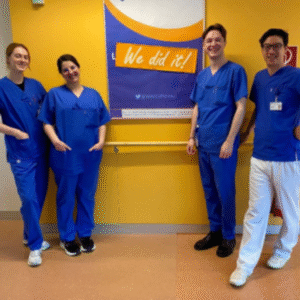
Hamburg is a vibrant and beautiful city, and I found it a very enjoyable place to stay. The atmosphere at UKE was extremely welcoming. My mentor, Priv.-Doz. Dr. Bastian Cheng, as well as all team members, were friendly, open, and always willing to explain clinical reasoning or procedures in detail. I felt fully integrated into the team and appreciated the collegial environment throughout my stay. A huge thank you to them!
Conclusions
My visit to UKE Hamburg was enriching both professionally and personally. I gained valuable clinical experience in stroke diagnostics and acute management, advanced my understanding of neurovascular interventions, and deepened my knowledge of essential diagnostic modalities.
Witnessing the organisation and efficiency of stroke care in a high-volume, research-active centre was particularly inspiring. I am deeply grateful to the European Stroke Organisation for supporting this programme and to UKE Hamburg for hosting me so warmly. This experience will significantly contribute to my future clinical work, academic development, and dedication to the field of stroke medicine.
ESOC is Europe’s leading forum for advances in research and clinical care of patients with cerebrovascular diseases. ESOC 2026 will live up to its expectation, and present to you a packed, high quality scientific programme including major clinical trials, state-of-the-art seminars, educational workshops, scientific communications of the latest research, and debates about current controversies. Learn more.
