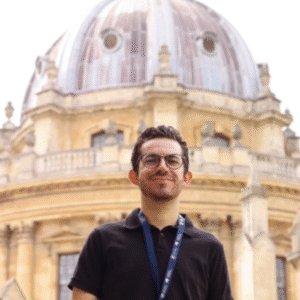
 Author: Gabriel Manrique Gutierrez
Host Institution: Oxford Centre for Integrative Neuroimaging, University of Oxford
The experience I had in Oxford and the knowledge I acquired over the past six months were highly meaningful and allowed me to grow both professionally and personally. This was made possible in part thanks to the funding provided by the European Stroke Organisation through its Department to Department Visit Programme. I am therefore very grateful for this support, as this research placement has enabled me to enrich my current project, which involves the application of a novel therapy using functional electrical stimulation coupled to a P300-based brain–computer interface for upper limb motor rehabilitation in chronic stroke survivors.
Spending six months studying and conducting research in Oxford was the most unique and special experience. At first, it was difficult to realise not only the fact that I was at one of the oldest universities in the world—where some of the brightest minds in history once shared the same libraries, laboratories, and lecture halls in which I was now standing—but also that the historic and quaint nature of its buildings, streets, and colleges creates the illusion that time has stood still, making you feel in a fairy tale or Harry Potter story.
Additionally, I was able to get the most out of my time in Oxford under the mentorship of Prof. Charlotte Stagg and Prof. Melanie Fleming, who served as my host co-supervisors within the Physiological Neuroimaging and Plasticity groups at the Oxford Centre for Integrative Neuroimaging. From the moment I arrived, I felt very welcome in their laboratories, and I was particularly impressed by the pleasant and friendly working environment I found there, where everyone was willing to help, fostering a dynamic of collaboration and cooperation that I greatly enjoyed.
Moreover, I would like to highlight the amazing academic and scientific activities in which I participated during my research stay. I learned how to analyse neuroimaging studies obtained from subjects in the project we are conducting in Mexico, including magnetic resonance imaging and electroencephalography studies. In addition, I also had the opportunity to get involved and assist in a clinical trial at the John Radcliffe Hospital, where we applied beta transcranial electrical stimulation to improve upper extremity motor recovery in stroke individuals. Furthermore, through various workshops, I learned how to apply other non-invasive brain stimulation and neuromodulation techniques, and I attended conferences, seminars and symposia that allowed me to appreciate different approaches and methodologies to conduct research.
Finally, I was not only able to learn and benefit from my time in Oxford, but I was also able to contribute my own skills. This included doing physical examination assessments for the clinical trial in which I participated in, as well as training other students on how to perform and evaluate different clinical scales used to assess motor function and recovery in stroke patients, given I was previously trained at a tertiary rehabilitation center in Mexico, the National Institute of Rehabilitation Luis Guillermo Ibarra Ibarra. The above demonstrates that bidirectional collaboration is possible and that both parties can learn and enrich each other.
ESOC is Europe’s leading forum for advances in research and clinical care of patients with cerebrovascular diseases. ESOC 2026 will live up to its expectation, and present to you a packed, high quality scientific programme including major clinical trials, state-of-the-art seminars, educational workshops, scientific communications of the latest research, and debates about current controversies. Learn more.
