The session “Looking to the Future” focused on the emerging and expanding capabilities of AI along the entire stroke care pathway.
It opened with a keynote debate on the question: “Will AI in stroke care always need human oversight?”
- Carlos Molina (Vall d’Hebron University Hospital, Barcelona, Spain) argued in favour of continued human oversight. He emphasised that oversight is not only a legal requirement but also essential because AI systems still fail in critical ways. He highlighted the risks of automation bias and underscored the ongoing need for effective human supervision—both now and in the future.
- Pietro Caliandro (Fondazione Policlinico Universitario A. Gemelli IRCCS, Rome, Italy) argued against, emphasising the potential for rigorously validated AI tools to operate safely and effectively without continuous human oversight. He pointed to the breadth of applications across the stroke care pathway where such tools may, after stringent evaluation, function autonomously.
The result was a spirited and humorous exchange that captured both the promises and challenges of AI in modern stroke care.
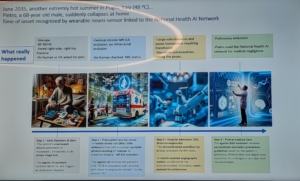
Minna Pikkarainen (Norway) presented on “AI Virtual Reality Solutions for Stroke Rehabilitation,” outlining ongoing efforts to integrate AI, virtual reality, and care networks to enable personalised, home-based rehabilitation.
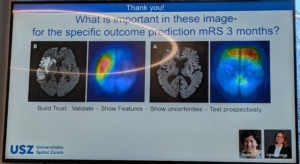
Susanne Wegener (Switzerland) followed with “AI Support Tools for Treatment Decisions in Stroke Patients.” She demonstrated that AI models can match or outperform stroke neurologists in predicting functional outcomes based on acute imaging. Current work includes improving outcome prediction using posture and movement recordings, integrating patient-related factors such as frailty, and developing models for treatment response and atrial fibrillation detection.
__
ESOC is Europe’s leading forum for advances in research and clinical care of patients with cerebrovascular diseases. ESOC 2026 will live up to its expectation, and present to you a packed, high quality scientific programme including major clinical trials, state-of-the-art seminars, educational workshops, scientific communications of the latest research, and debates about current controversies. Learn more.
