
Session IV presented a compelling overview of how biomarkers are reshaping stroke research and care. Speakers explored biological precision, neuroimaging insights and cardioembolic risk stratification, highlighting where biomarkers can provide real clinical value.
BIOSTROKE Consensus Recommendations
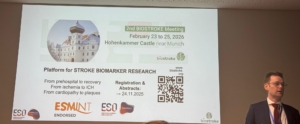
John McCabe (Ireland) opened with the BIOSTROKE consensus, developed to address fragmented study designs, small heterogeneous cohorts and inconsistent reporting. His message was clear: precise diagnosis, better risk stratification and more personalised treatment require more biological resolution than clinical tools alone can offer.
BIOSTROKE used a Delphi process to identify priorities across five domains:
- Pre-hospital care
Current triage tools perform poorly for intracerebral haemorrhage (ICH) and large-vessel occlusion (LVO). Promising candidates include GFAP and portable EEG, but these require validation in real-world EMS environments. Feasibility, speed and cost are crucial. Priority areas include biomarkers applicable to all stroke-code activations, rapid subtype identification and compatibility with pre-hospital constraints. - Ischaemic stroke progression and recovery
Stroke evolves dynamically, whereas imaging captures a single moment. Biomarkers such as BD-tau, S100B and neurofilament light chain (NfL) may help track injury and guide treatment. The priority is markers that respond to interventions, predict recovery and reflect underlying processes rather than static outcomes. - Atrial cardiopathy
Atrial cardiopathy may precede atrial fibrillation (AF), offering opportunities for early detection and prevention. Natriuretic peptides, inflammatory biomarkers, ECG-derived metrics and imaging features can identify high-risk patients. Priorities include detecting atrial cardiopathy, predicting post-stroke AF and assessing risk for cardiovascular events or cognitive decline. - Atherosclerosis
Stenosis alone cannot capture plaque biology. Combining advanced imaging with multi-omics may reveal vulnerable plaques and improve patient selection for revascularisation. Priorities include detecting culprit lesions, refining vascular risk and guiding prevention strategies. - Intracerebral haemorrhage
Aetiology remains undetermined in up to 30% of ICH. APOE, amyloid PET and CSF amyloid can help diagnose conditions such as CAA, but new markers are needed to predict haematoma expansion, oedema and recurrence. Key areas include differentiating ICH causes, predicting responses to acute therapy and identifying markers linked to cognitive outcomes.
Across domains, McCabe highlighted the need for harmonised sample handling and standardised workflows to enable multicentre data aggregation. He called for coordinated collaborations and integration of biomarker substudies in future trials, with the 2nd BIOSTROKE Meeting in 2026 as the next key step.
Neuroimaging Biomarkers: Utility vs. Biology
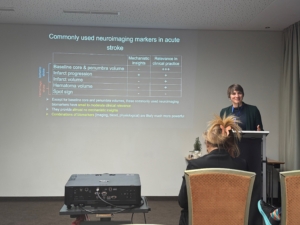
Johanna Ospel (Canada) offered a crisp review of imaging biomarkers, questioning how many actually inform stroke biology. Baseline core–penumbra estimates remain clinically relevant—especially for late EVT and borderline IVT decisions—but provide limited mechanistic insight and rely on arbitrary thresholds.
By contrast, infarct progression rate captures the pace of injury and better reflects biological dynamics, though its measurement is complex. Final infarct volume predicts outcomes but is retrospective and biologically uninformative.
In ICH, haematoma volume remains the strongest clinical predictor and shapes trial eligibility. The spot sign, once promising, has proven inconsistent outside controlled settings. Recent trials emphasise treatment timing rather than radiographic positivity.
Ospel concluded that most imaging biomarkers, beyond core–penumbra assessment, fail to explain mechanisms. She argued for integrating imaging with blood-based and physiological markers to develop composite indicators that capture injury and repair.
Neuroprotection: Why We Missed—and What Could Change
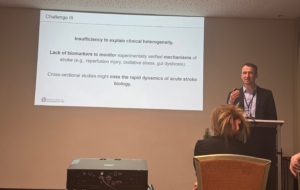
Steffen Tiedt (Germany) explained why decades of neuroprotection trials have failed: weak biomarkers, inefficient designs and lack of physiologically meaningful endpoints. Among promising candidates, NfL stands out. Already validated in multiple sclerosis, NfL reflects neuroaxonal injury and correlates with infarct volume.
In the ESCAPE-NEXT biomarker substudy (n=193), NfL predicted functional outcome and tracked treatment effects. Patients achieving full reperfusion (eTICI 3) had a 61% smaller rise in NfL over six days, while nerinetide attenuated NfL elevation—suggesting its value as a surrogate of tissue preservation.
Still, gaps persist: the field lacks tools for high-frequency monitoring and biomarkers that map individual recovery trajectories or identify responders. Tiedt pointed to two studies:
- PROMISE (n=502): combines serial blood sampling and imaging to chart injury dynamics.
- PROMISE-BD-100: measures proteomic and metabolomic changes hourly over the first 48 hours to identify biological response patterns.
He also highlighted brain-derived tau (BD-tau), a CNS-specific isoform that may complement NfL by improving specificity for neuronal injury. His practical advice: “Take a blood sample at discharge.”
Cardioembolic Risk and Personalised Secondary Prevention
Jesse Dawson (UK), on behalf of BIOSTROKE, discussed biomarker-driven strategies for cardioembolic stroke diagnosis and prevention. Many embolic strokes remain cryptogenic because AF is intermittent or develops later. Biomarkers of atrial pathology can identify high-risk patients before AF is documented.
Evidence across cohorts positions MR-proANP as a powerful marker. In the BIOSIGNAL cohort (n=1,759), MR-proANP was the strongest predictor of newly detected AF, with an odds ratio >35. In the PRECISE study, both NT-proBNP and MR-proANP improved patient selection for monitoring, though MR-proANP showed slightly higher diagnostic accuracy. Combining age with MR-proANP reduced the need for prolonged monitoring by ~40%, compared with ~34% using NT-proBNP.
Clear risk bands emerged: <92 pmol/L (low), 92–200 (moderate), >200 (high). Individuals in the highest strata benefit most from intensified rhythmological evaluation.
Beyond blood biomarkers, Dawson emphasised Excessive Supraventricular Activity (ESVA) — defined as >30 ectopic beats per hour or runs of >20 beats over 24 hours — used in Find-AF-2 to guide structured, repeated rhythm monitoring or device implantation. Combining structural, electrical and circulating biomarkers may allow true personalised secondary prevention.
Biomarkers are moving from exploratory tools to functional clinical instruments. Their future impact will depend on harmonised standards, reproducible study design and broad collaboration across centres and disciplines. Session IV underscored that the path forward lies not in single markers, but in integrating biological, imaging and physiological information to guide precision stroke care.

__
ESOC is Europe’s leading forum for advances in research and clinical care of patients with cerebrovascular diseases. ESOC 2026 will live up to its expectation, and present to you a packed, high quality scientific programme including major clinical trials, state-of-the-art seminars, educational workshops, scientific communications of the latest research, and debates about current controversies. Learn more.
