The second Friday session at the ESO Garmisch Stroke Science Workshop focused on methodology in stroke research. Convened by Dr Annemijn Algra (Netherlands) and Dr Jean-Marc Olivot (France), speakers addressed how clinical trials, emulated studies, genetics and imaging can shape the next decade of stroke science.
Optimising future randomised trials
Keynote speaker Dr Ashkan Shoamanesh opened with one of the most persistent dilemmas in hyper-acute stroke trials: informed consent. Deferred consent can speed enrolment and preserve critical treatment windows but also raises ethical questions—particularly when patients or relatives withdraw participation after randomisation. Dr Shoamanesh stressed that trial feasibility, autonomy and transparency must be balanced case-by-case.
To improve trial efficiency, he highlighted hybrid automated adjudication systems (AutoEAS). Used in trials such as COMPASS and ANNEXa-I, these systems combine automated classifiers with human review for ambiguous events. They reduce adjudication time without compromising accuracy and may help standardise outcome assessment across centres.
He then discussed adaptive sample-size re-estimation, which allows recruitment to be adjusted according to interim information. This approach, seen in INTERCEPT and other ongoing programmes, can prevent underpowered trials and avoid wasteful over-recruitment. While not relevant to every design, adaptive methods are well-suited to heterogeneous stroke populations where treatment effects vary.
Dr Shoamanesh closed with an overview of the win ratio, a hierarchical method that compares outcomes between treatment groups according to clinical priority – such as mortality, major disability and recurrent stroke. The approach can reveal benefits masked by conventional composites, but is sensitive to censoring and small sample sizes, and is less intuitive in non-inferiority frameworks. Even so, it offers a promising alternative when patient-centred outcomes are multidimensional.
Target Trial Emulation
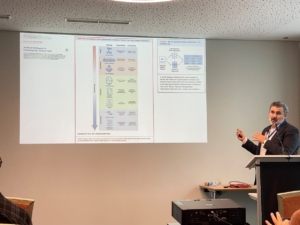
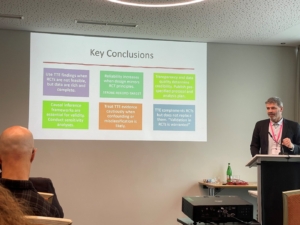
Dr Daniel Strbian (Finland) introduced Target Trial Emulation (TTE) as a tool when RCTs are unavailable or impractical. By reconstructing the framework of an “ideal” trial within high-quality observational datasets, TTE can strengthen causal inference. Reliable exposure definitions, outcome accuracy and linkage across registers are essential to prevent bias and missingness.
However, he cautioned that TTE cannot solve all problems. Behavioural and procedural interventions—where clinician decision-making and adherence drive outcomes—are poorly emulated. Low-quality data undermines validity, and no emulation can replicate randomisation. TTE therefore complements but does not replace RCTs, helping to fill knowledge gaps and guides whether and how future trials should be conducted.
Genetics-guided drug discovery
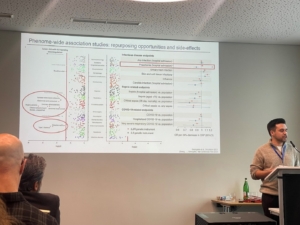
Dr Marios Georgakis (Germany) spoke about integrating human genetics and multi-omics into drug development. Traditional biomarker studies, he noted, frequently identify associations but not causation. Genetic variants, in contrast, provide a natural anchor for causal inference.
Using IL-6 signalling as an example, he showed how variants affecting IL-6 and its receptor can mimic pharmacological inhibition. These “genetic instruments” allow researchers to predict clinical consequences of pathway modulation—before launching trials. They also help select appropriate patient subgroups and endpoints. Trials informed by human genetics, he argued, are two to three times more likely to succeed than conventional approaches.
Multi-omics further refines target selection, integrating proteomic, transcriptomic and metabolic information across tissues. Instead of identifying biomarkers retrospectively, genetics-informed discovery moves development upstream and increases the probability that candidates reach clinical benefit.
Molecular imaging as a translational bridge
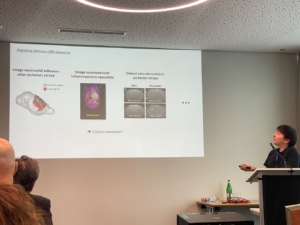
In the final talk, Dr Maxime Gauberti (France) explored how advances in preclinical imaging can accelerate translation. Animal models often depend on destructive histological endpoints, which rarely align with human clinical practice. Molecular imaging, he suggested, enables non-invasive assessment of pathology in vivo, maintaining anatomical context.
Using a mouse model of primary cerebral vasculitis, his team identified endothelial adhesion molecules—VCAM-1 and E-Selectin—as indicators of neurovascular inflammation. VCAM-1–targeted particles detected vessel wall infiltration in vivo, mirroring histological findings. Beyond diagnosis, such imaging permits longitudinal tracking, evaluation of therapeutic effects and identification of candidates realistic for early-phase trials.
Dr Gauberti emphasised that preclinical imaging is not only a window into animal disease. It can inform clinical translation, select meaningful biomarkers and refine how human treatments are evaluated—particularly in inflammatory and vascular disease.
Session II highlighted a shared message: advancing stroke science depends not only on better therapies, but on better methods. Adaptive trial designs, robust emulation strategies, genetics-anchored targets and translational imaging all bring stroke research closer to clinical reality.
Many thanks to the convenors and invited speakers for an inspiring session.
__
ESOC is Europe’s leading forum for advances in research and clinical care of patients with cerebrovascular diseases. ESOC 2026 will live up to its expectation, and present to you a packed, high quality scientific programme including major clinical trials, state-of-the-art seminars, educational workshops, scientific communications of the latest research, and debates about current controversies. Learn more.
