Author: Grégoire Boulouis and Floris Schreuder
Session I, convened by Grégoire Boulouis and Zuzana Gdovinová, opened the workshop with high energy and a strong scientific pulse, centered on acute reperfusion strategies and the evolving landscape of mechanical thrombectomy (MT). A lively debate on intra-arterial thrombolysis (IAT) after MT set the tone, followed by two forward-looking presentations on neuroprotection and device innovation. The auditorium remained deeply engaged throughout, with active discussion and expert insights reflecting the spirit of the ESO Stroke Science Workshop.
Intra-Arterial Thrombolysis After Mechanical Thrombectomy: Evidence, Risks, and Rationale—A Structured Debate
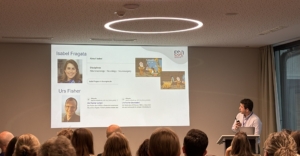
The chairs introduced the session’s core question—whether intra-arterial thrombolysis should be used following mechanical thrombectomy—before inviting a pre-vote. This seamlessly launched into the keynote debate. Urs Fischer opened with a punchy, data-driven case for “giving the juice.” He highlighted recent evidence, including the disproportionate effect size observed in the CHOICE trial, while underscoring the need for replication before changing practice. Ongoing trials such as TECNO, he noted, will be essential to clarify the true benefit and magnitude of post-MT IAT.
Isabel Fragata delivered an equally dynamic and humorous counterargument. Drawing from real-world cases, she illustrated bleeding complications after post-MT lysis and explained why, from a pragmatic and mechanistic standpoint, IAT after MT may be illogical. She raised concerns about internal lysis, micro-catheter-related thrombus injection, and overall procedural risk, arguing that the theoretical and practical downsides outweigh the potential benefits.
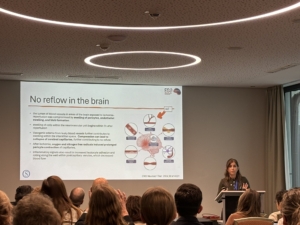
Rebuttals from both speakers kept the audience fully engaged, and comments from the floor added further nuance. An audience vote captured evolving opinions, followed by a short but animated discussion that emphasized the need for better evidence and clearer guidance.
Advances in Neuroprotection: Translational Pathways Toward Enhanced Reperfusion Outcomes
The session then shifted toward future horizons in acute stroke care. Macarena Hernández-Jiménez delivered a compelling translational presentation on neuroprotection, outlining experimental advances and their potential synergy with MT. She made a convincing case for continued investment in this field, emphasizing that augmenting reperfusion with neuroprotective strategies may be key to improving outcomes.
Technological Evolution of Thrombectomy Devices: Innovations Shaping Acute Reperfusion Therapy
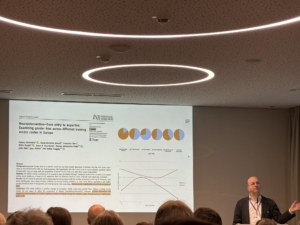
Uta Hanning followed with an excellent overview of technological progress in thrombectomy. She traced the historical evolution of MT devices, progressing from early stent retrievers to double-stent techniques, thrombus-specific tools, and the development of large-bore aspiration systems. Her talk highlighted how engineering refinements continue to influence procedural success and may ultimately drive better clinical outcomes.
The final discussion brought the session to a close in a vibrant atmosphere. The audience raised thoughtful questions, and the collective exchange underscored both the complexity and the momentum of current research in acute reperfusion. Altogether, the session delivered a concentrated moment of science, debate, and forward-looking insight in the pure spirit of the ESO Stroke Science Workshop.
__
ESOC is Europe’s leading forum for advances in research and clinical care of patients with cerebrovascular diseases. ESOC 2026 will live up to its expectation, and present to you a packed, high quality scientific programme including major clinical trials, state-of-the-art seminars, educational workshops, scientific communications of the latest research, and debates about current controversies. Learn more.
