For the first time, the organisers of the 8th European Stroke Science Workshop launched a dedicated Pre-ESSW Mid-Career Workshop, designed to foster collaboration and career development. The result? A warm conference icebreaker and a vibrant networking hub for stroke researchers in the mid-career stage.
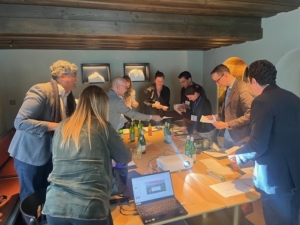
The afternoon opened with ESSW Chair Rustam Al-Shahi Salman, followed by co-chairs Signild Åsberg and Annemijn Algra, who led two mid-career groups into the first session: an elevator-pitch challenge. Volunteers presented a strictly timed three-minute pitch (three slides maximum) about their upcoming research. The organising committee scored each pitch on originality, potential impact, and clarity, while peers provided one “tip” and one “top” on paper notes. The concise format sparked lively debate, enthusiastic feedback, and several promising ideas for collaboration—proof that overlapping research themes quickly build bridges.
After a short break, the group reconvened for an introduction to narrative CV writing. Signild and Annemijn set the tone by asking participants to share a recent achievement they were proud of and the impact it created. The room filled with conversations—some of those achievements were not visible in conventional metric-based CVs. Using provocative statements and historical examples (including 18th-century precursors), the group discussed strengths and limitations of narrative CVs. A key takeaway: hybrid formats—such as the Luxembourg National Research Fund template—may be a pragmatic way forward, blending metrics and narrative in a concise and transparent manner.
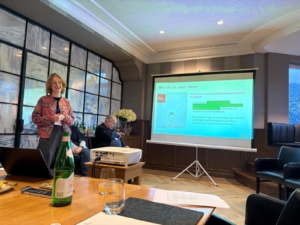
The closing session was an intimate conversation with Gabriel Rinkel, world authority on subarachnoid haemorrhage and intracranial aneurysms. Rather than standing at the front of the room, he sat among the participants and shared honest lessons from his career as a clinician, teacher, researcher, and head of department. From strategies to find focused writing time to receiving—and later providing—mentorship, Gabriel emphasised one recurring message: international collaboration and friendships shape not only our scientific impact, but also our happiness in academic life.
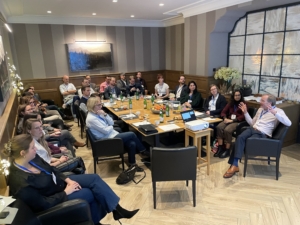
Before closing, Gabriel announced the winners of the elevator-pitch challenge:
- Nina Hilkens (Netherlands) — “Lifelong Antiplatelet Therapy After Ischemic Stroke: Time to Change the Dogma.”
- Jatinder Minhas (United Kingdom) — “Protective and Reparative Processes After Acute ICH – Can We Recruit These or Do They Present a Risk?”
On behalf of the ESSW organising committee, we extend our thanks to all mid-career researchers for their preparation and active participation. You turned this inaugural workshop into a genuine success—one that will undoubtedly return at ESSW 2027.
_
ESOC is Europe’s leading forum for advances in research and clinical care of patients with cerebrovascular diseases. ESOC 2026 will live up to its expectation, and present to you a packed, high quality scientific programme including major clinical trials, state-of-the-art seminars, educational workshops, scientific communications of the latest research, and debates about current controversies. Learn more.
